
Essays · Photography
Iñaki Bonillas. Marginalia.
The margin of a photograph is also a photograph.
A name borrowed from the margins of books
Marginalia is the word for handwritten notes in the margins of a book. The English poet Samuel Taylor Coleridge brought the word into English, as he habitually filled the margins of the books he read. Bonillas has said he finds those notes funnier and more eloquent than the texts they sit beside.
Iñaki Bonillas, a Mexican artist, borrowed the name for a series begun in 2019. But the margins here are not in books. They are the margins of photographs.
A printed photograph always has a border. The strip of white paper around the image, the edge of the film, the corners trimmed away for framing. It is empty space, the negative of the picture, something we look through to reach the image. Bonillas asks the opposite question: what if we looked straight at the margin?
Building pictures from what is discarded
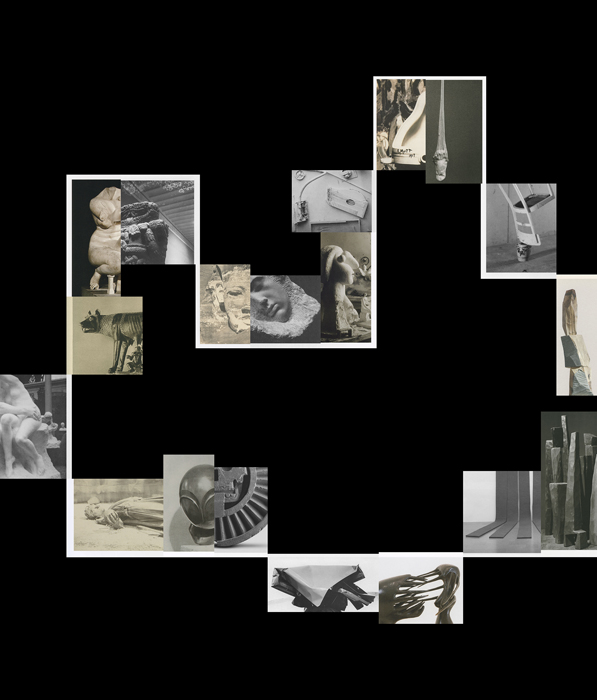
Bonillas selects fragments of photographs, digitises them, and assembles them into new compositions. The margin that used to be background becomes the figure. Horizontal strips are turned upright. Out of black and white, colour appears.
One work in the series, Marginalia 4, shows gestures of the hand. It was composed from old photo colouring manuals and analogue photographic techniques. Before colour film was common, many photographs were tinted by hand, a little at a time. Those manuals taught the colourist how to hold a brush, how to mix a tint, how to make a cheek look pinker.
The series is therefore also an acknowledgement. Every old photograph is the work of many people whose names we never learn: the darkroom printer, the colourist, the framer. Their labour sits at the edge of the picture, unsigned. Bonillas brings them to the centre.
While making Marginalia, Bonillas noticed that his studio floor was covered in scraps of photographic paper. He gathered them, placed them in a glass case, and had a professional photographer light them with studio lamps. The margin of the margin became a work too.
An artist of the archive
Photography reached Bonillas early, through a family archive. His grandfather, José Rodríguez Plaza, was a Spaniard living in exile in Mexico who photographed constantly. From 2003 Bonillas began bringing that archive into his own work, and it grew into a long project called the J. R. Plaza Archive.
Through that archive Bonillas came to see photography as matter more than image. A photograph has paper, chemistry, edges, a back, fingerprints. It is kept in albums, glued down, annotated. Marginalia is the next step in that way of seeing: after reading an archive closely, he began to read what had been cut away from it.
Marginalia was also the title of Bonillas's first solo exhibition in New York, at kurimanzutto's space on East 65th Street, from 5 October to 7 December 2019. The show set three groups of works side by side, all concerned with the physical matter of photography.
What makes the series memorable is its modesty. No beautiful view, no decisive moment. Only what is left over once the main picture is done. And it turns out that what is left over has its own shapes, its own colours, its own story.
Photography