
Essays · Photography
Irina Rozovsky. Miracle Center.
The frame changes the picture.
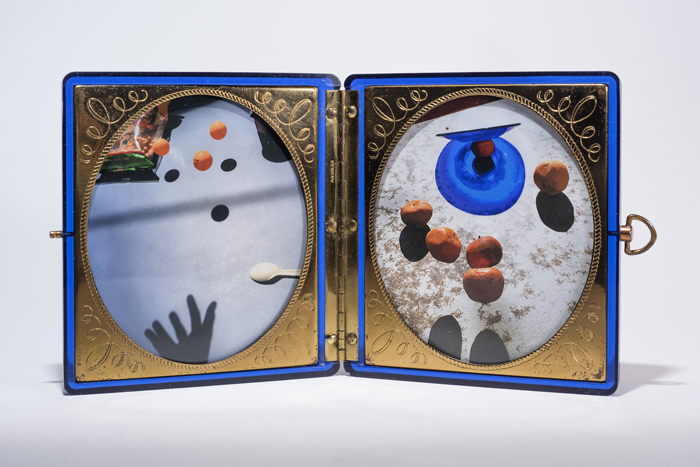
New photographs, old frames
Irina Rozovsky is a photographer born in the former Soviet Union and working in the United States. For years she has photographed the life around her: family, friends, trees, corners of the house, light on a wall. The pictures do not need a big event. They come from ordinary days.
In 2019 she began Miracle Center. The method is simple. She hunts for old picture frames in antique shops and on eBay. Then she prints her own photographs, trims them to fit, and sets them inside.
Many of the frames are travel frames, small and folding, made so people could carry pictures of loved ones on a journey. Some are only a few centimetres across. One work from the series in the collection of the High Museum of Art in Atlanta is an inkjet print of roughly three by two inches, held in a frame chosen by the artist.
The results are small objects that fit in the palm of a hand. A photograph taken last week, in a frame that may be decades old.
The frame is not silent
In a gallery, frames are usually chosen to disappear. Thin edges, neutral colours, nothing to distract. Rozovsky does the opposite. Her frames have ornament, colour, scratches, gilding that has worn away. They speak.
When a picture of a backyard tree goes into an old gilt frame, the picture changes its tone. It looks more precious, more private, like a keepsake. When a face goes into an oval frame, we find ourselves reading it as a portrait of someone long gone, though the person is alive. The colour, shape and ornament of the frame steer how we look before we have time to think.
Rozovsky has described the series as an invitation to play with time and visual space. The frame pulls the photograph into the past. The photograph pulls the frame into the present. The viewer stands between them, unsure whether she is looking at an object from today or from many years ago.
It is also a small lesson about photography. A picture has no fixed meaning. Its meaning shifts with where it is placed: in a wallet, on a family altar, on a museum wall, on a phone screen.
Why these small objects stay with you
In 2020, Miracle Center was shown in New Photography, the Museum of Modern Art's recurring exhibition of new work in the medium. The museum's curator noted that the frames turn the photographs into intimate, precious objects that evoke history while keeping the spontaneity of the moment they were taken.
At a time when most photographs live only on screens, Miracle Center brings photography back to objects. A framed picture has weight. It has a back, a hinge, a pane of glass. It can fall, break, be laid face down.
And because the frames are second hand, each work carries a history nobody can tell. Who bought this frame? Whose picture did they keep in it? How did it end up in an antique shop? Rozovsky does not answer. She only sets a new photograph inside, and lets the two stories sit side by side.
The title, Miracle Center, sounds like a sign over a door somewhere. Rozovsky does not explain it much. But looking at these small objects, the miracle seems an ordinary one: an ordinary day, kept, in a frame that fits the hand.
Photography