
Essays · Contemporary Art
J.P. Sniadecki, Joshua Bonnetta. El Mar La Mar.
The desert keeps every footstep.
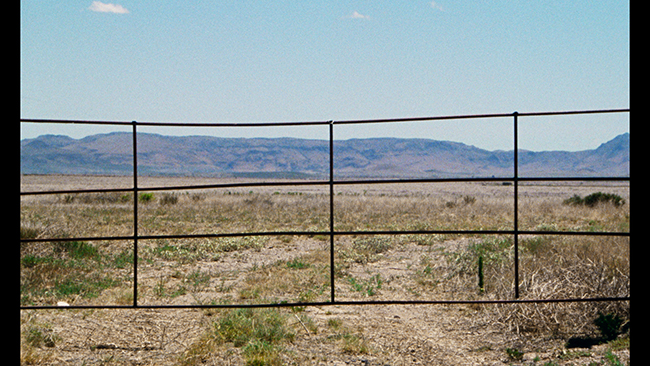
Three years for one desert
J.P. Sniadecki and Joshua Bonnetta spent three years making El Mar La Mar. They shot on 16mm film, which has to be sent off and developed before you know what you have. Every roll meant waiting. The pace slowed, and that slowness found its way into the film.
The place is the Sonoran Desert, dry land that spans both the United States and Mexico. A border runs straight through it. Many migrants cross on foot because no other route is open to them. The sun is fierce, the nights cold, water scarce. Some do not make it.
Sniadecki has said that at first they were not trying to make a film about the border at all. They wanted to make a film about the desert. The border simply happens to cross it. Their aim was to understand a space, not to illustrate an issue.
That choice shapes everything after it. There is no narrator explaining the situation. No charts, no figures. Only land, sky, and what people leave behind.
Three chapters, one terrain
El Mar La Mar runs 94 minutes, in three chapters. The images move from close details to vast open views, then to passages that are almost abstract, where light and dust fill the whole frame. It was shot at every hour, in every kind of weather. Noon, deep night, rain, wind.
Sound stands level with the picture. Wind through brush, feet on gravel, silences so long the viewer starts to hear their own breathing. In places the screen is nearly dark and only sound remains.
Between them come voices, most of them unseen. Migrants describing the crossing. Border patrol agents talking about their work. Local residents. Volunteers who leave water along the trails. Hikers who came upon bodies. And one man telling of a monster that lives somewhere out in the desert.
These voices are not arranged into an argument. They sit side by side, like layers of soil. The viewer has to listen and place them alone.
Why the film stays
Sniadecki had worked with Harvard's Sensory Ethnography Lab, a group that makes nonfiction film by putting the senses ahead of explanation. El Mar La Mar carries that spirit. It is a documentary that stands very close to experimental cinema.
The film premiered in the Forum section of the Berlin International Film Festival in 2017 and won the Caligari Film Prize there. The Museum of Modern Art in New York later added it to its collection.
What sets it apart from many border films is the distance it keeps. It does not pull the viewer to one side. It lets the desert be the main character, beautiful and dangerous, neither kind nor cruel. People pass through, leave marks, and disappear.
Afterwards you remember little plot, because there is almost none. You remember heat, wind, the colour of dust in late afternoon. The film stays in the body more than in the mind. Perhaps that is the only way to understand a place like the Sonora: stand long enough, listen closely enough, and accept that some things you will never see with your own eyes.
Contemporary Art