
Essays · Olfactory Art
Maki Ueda. Olfactoscape Ver. 1.
A landscape not to look at, only to walk through.
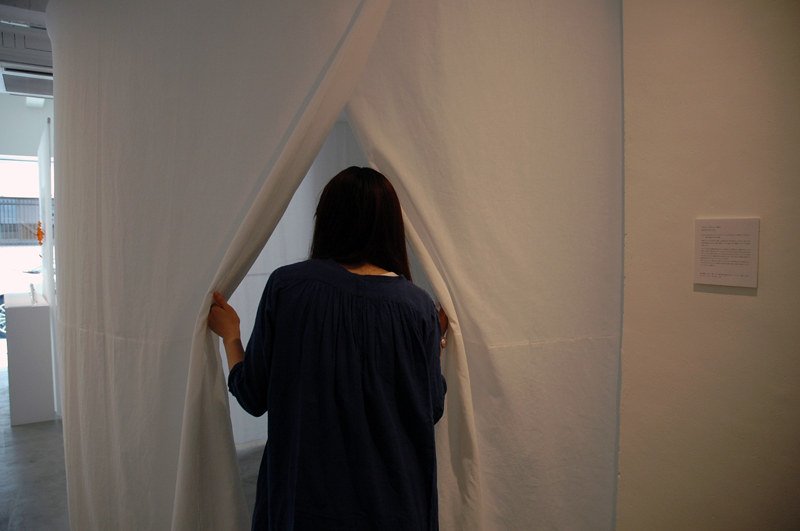
A ring of curtain, no image
In 2010 Maki Ueda built the first version of Olfactoscape in Osaka. The work is a circular space three metres across, enclosed by curtain. Nothing is printed on the curtain, nothing is projected. From outside it looks almost empty.
But the surface of the curtain has been painted with smell. Each scent sits at a particular point, invisible to the eye. Visitors are invited to close their eyes, walk slowly and sniff. Some scents come closer. Others fade away.
The list is precise: hinoki, camphor, lily of the valley, cherry blossom, wild rose, forest with fallen leaves, ginger, yuzu, matsutake, wild lily, cinnamon, grass. None has an abstract name. Each is a tree, a flower, a patch of ground.
This version was produced by Inframince, sponsored by Yamamoto Perfumery, and installed by Pantaloon together with the artist. Olfactoscape later grew into further versions, each testing another way of placing scent in space.
Seeing with the nose
The title is a word Ueda coined: olfacto, relating to smell, and scape, as in landscape. She describes Olfactoscape as a research project into the limits and possibilities of the sense of smell.
The question is simple: can one view a landscape through the nose? Ueda does not answer with theory. She builds a room for others to try. The person walking the ring is reading a map. Each step is a coordinate.
Here distance becomes part of the scent. In daily life we rarely notice that smell has direction and range. We smell bread before we see the bakery, rain before it arrives. Olfactoscape takes that familiar fact and folds it into three metres of curtain.
A landscape painting shows the whole view at once. Smell does not. It arrives one piece at a time, in sequence, with the breath. So Ueda's landscape has time inside it. It is not a photograph. It is closer to a walking path, with a start, a middle, and a place to turn back.
With eyes closed, the body has to work differently. The walker relies on the nose to know where they are. The landscape is not on the curtain. It forms inside the walker, piece by piece, in the order they meet each smell.
Season and place in a name
Ueda is a Japanese artist who has worked for many years in the Netherlands, with smell as her main material. Her choice of scents for Olfactoscape reflects a Japanese way of seeing nature: seasons recognised through particular trees and flowers.
Cherry blossom belongs to spring. Matsutake belongs to autumn. A forest of fallen leaves is the end of the year. Hinoki is the wood of baths and shrines. Each smell carries a time of year and a kind of place. Arranged around a circle, they become something close to a calendar made of scent.
This way of seeing is familiar well beyond Japan. Many places mark their seasons by smell: a flowering tree at the turn of winter, straw after harvest, earth when the first rain lands. Ueda simply lifts such smells away from their trees and soil and sets them again inside a room, so we can see they were always a map.
What stays with you is the restraint. No sound, no special lighting, no image. Only curtain, empty space and smell. The work trusts the nose to do what we usually hand to the eyes.
And so each person leaves with a landscape of their own. Someone who grew up near conifers finds the hinoki first. Someone who cooks a lot finds the ginger and cinnamon. One ring of curtain, and no two maps alike.
Hình ảnh: Maki Ueda, Olfactoscape Ver. 1, installation view, Osaka (2010). Trích dẫn cho mục đích phê bình nghệ thuật phi thương mại theo nguyên tắc fair use học thuật. Nguồn nghệ sĩ: ueda.nl.
Image: Maki Ueda, Olfactoscape Ver. 1, installation view, Osaka (2010). Reproduced for non-commercial art criticism under principles of academic fair use. Artist source: ueda.nl.

Olfactory Art