
Essays · Contemporary Art
Rael San Fratello. Teeter Totter Wall.
When one end goes down, the other rises.
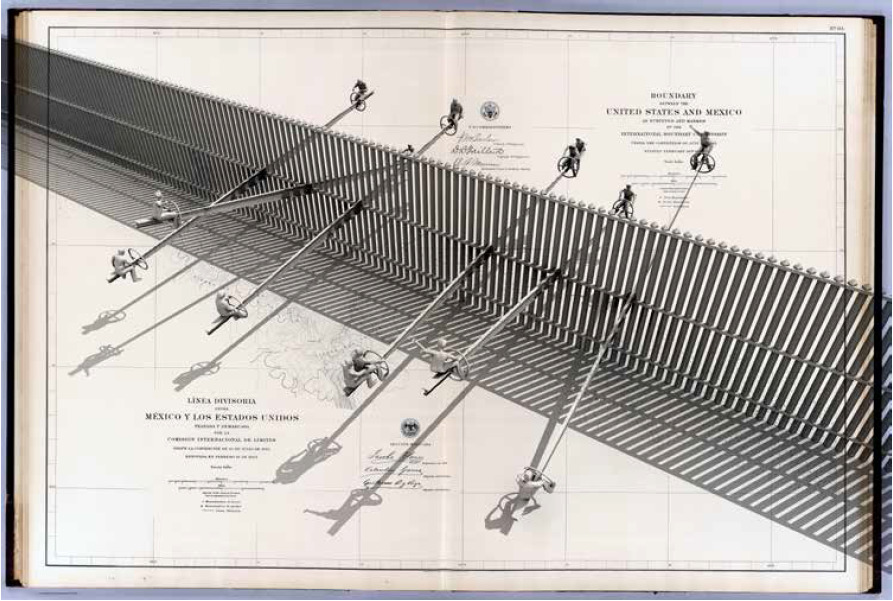
Proposals for a wall
Ronald Rael and Virginia San Fratello are architects who work together as Rael San Fratello. From the early 2000s they began drawing proposals for the border wall between the United States and Mexico. Not to build more of it. Not to tear it down. To ask: what else could this wall be used for?
They drew on real stories. On both sides, people kept finding ways to turn the wall into something else, often in surprising ways. Rael San Fratello recorded them, then kept drawing.
The list of proposals is long. Some are playful: a xylophone fixed to the steel posts, a volleyball net. Some are infrastructure: water treatment, solar panels. Some serve a community: a library, a birthing centre. Some belong to nature: a row of cactus, a corridor for wildlife.
In 2017 many of these ideas were gathered in Ronald Rael's book Borderwall as Architecture.
An etching, then three teeter totters
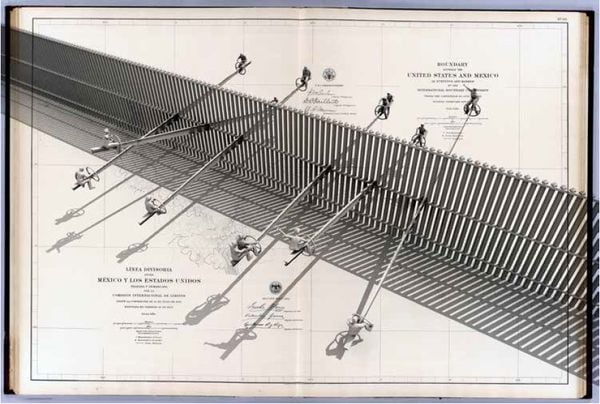
The teeter totter idea was sketched around 2009. In 2014 it became an etching: boards slipped through the gaps of the wall, one end in each country. The print, 61 × 76.2 cm, is now in the collection of the Museum of Modern Art in New York.
For years it remained a drawing. Then United States border policy became a charged subject, with plans to extend the wall and the separation of migrant families. Rael San Fratello decided to take one proposal off the page.
On 28 July 2019, together with Colectivo Chopeke from Ciudad Juárez, they installed three pink teeter totters through the steel slats. To the north, Sunland Park, New Mexico. To the south, the Anapra neighbourhood of Ciudad Juárez. One team on each side pushed the boards into place.
Then children and adults on both sides sat down. In less than an hour the teeter totters were taken away.
The fulcrum
A teeter totter is an image so simple anyone understands it. Rael San Fratello chose it for a reason. It works through a pivot. As Rael has explained, the wall is that pivot in the relationship between the two countries: what happens at one end directly affects the other.
It is a metaphor, and also a physical fact. The person on the Mexican side cannot rise unless the person on the American side goes down. Each has to take the other into account.
The pink was a choice too. Among rust coloured steel and dry ground, three pink boards stood out, light and clear, unlike anything that belongs to a border structure.
Why the work stays
Teeter Totter Wall changed no policy. It did not take down the wall. It existed for less than an hour. But the videos and photographs of that afternoon travelled far.
In January 2021 the Design Museum in London named the project Beazley Design of the Year 2020, ahead of nominees in categories such as architecture, graphics, product and fashion.
What makes the work stay is its scale. A very large problem, answered with a very small toy. No manifesto. No banner. Only a board, a pivot, and two people at either end who have to watch each other to keep their balance.

Contemporary Art