
Essays · Contemporary Art
Gretchen Bender. Dumping Core.
With too many images, nothing is seen.
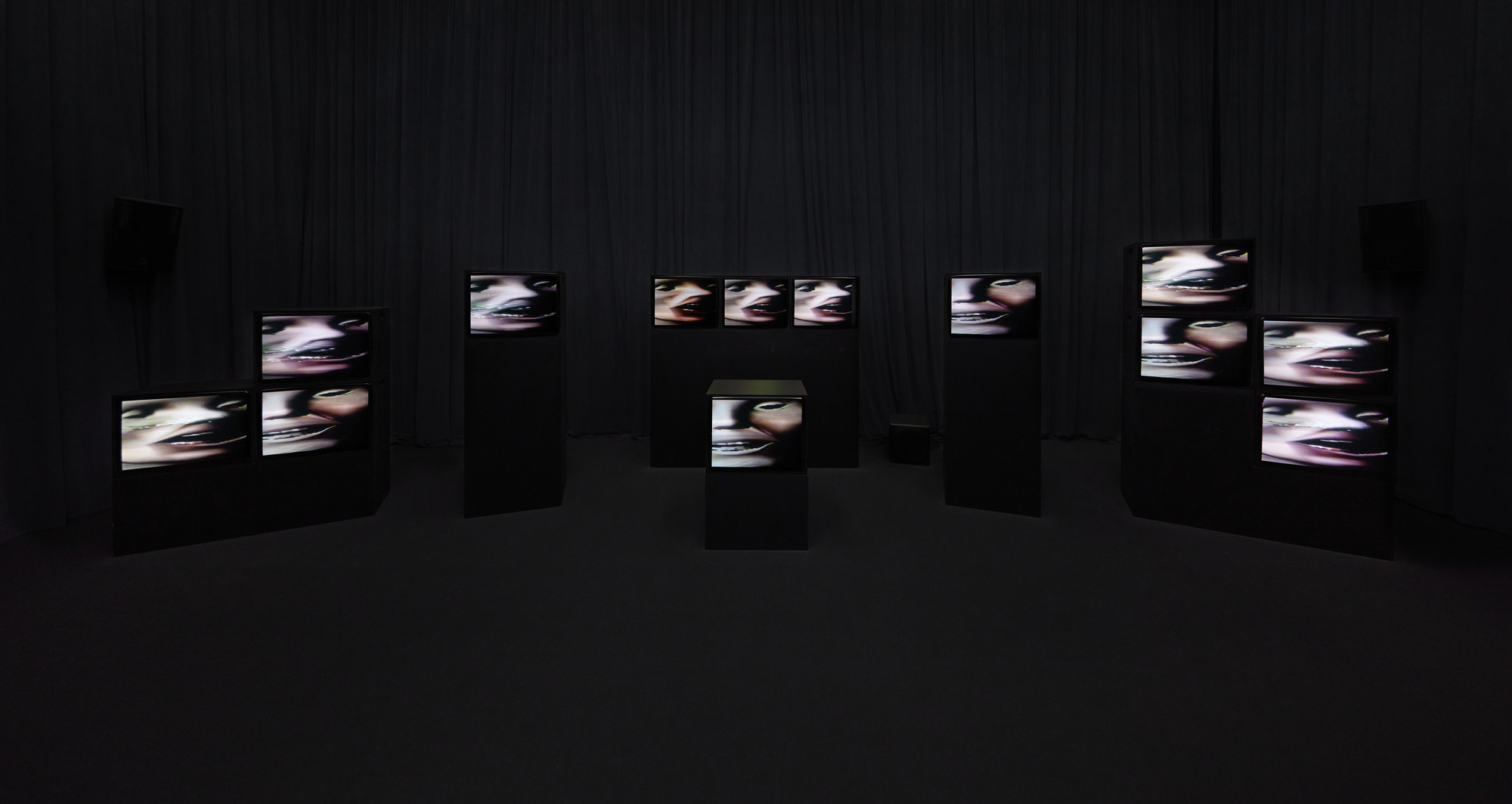
Thirteen screens in a dark room
In 1984 Gretchen Bender made Dumping Core. The work consists of four channels of video, thirteen minutes long, programmed to play in shifting combinations across thirteen synchronized monitors. No characters. No plot. Only images arriving in a rush.
On the screens: television graphics, corporate logos lifted from broadcast TV, fragments of advertisements, programs and films. Cut in among them are images of the civil war in El Salvador. The computer animation was made with Amber Denker. The electronic soundtrack is by Stuart Argabright, a pulse close to techno before techno had a name.
Bender first conceived the piece as a performance, an electronic theater with live music. It later lived on as a gallery installation. The work is in the collection of the Museum of Modern Art in New York, where from October 2019 to June 2023 it was shown on CRT televisions in a darkened room.
A television maker against television
Bender did not stand outside the world she criticized. She worked commercially on music videos, advertisements and television shows. She knew exactly how images were cut, assembled and sold. Knowing it so well made her suspicious.
In the early 1980s American television was changing pace. CNN ran news around the clock. MTV turned songs into chains of fast cuts. Computers could now draw spinning logos, flying type, glossy surfaces. For Bender this was both a new frontier for visual expression and a tool of psychological pressure.
Her answer was not to step away. She imitated television and then pushed it too far. She once said, in effect, that she would mimic the media but turn the voltage up so high that viewers would be jolted into awareness. She also compared the media to a river that devours: no mind, only absorbing and converting.
Dumping Core is that river, placed in a room. The viewer cannot swim. They can only stand there and be carried.
A record before the crash
The title comes from an early computing term. A core dump is a record of a computer's entire memory, saved just before the system stops. Engineers read it to understand why the machine failed.
The word core points somewhere else too. In 1979 the reactor at Three Mile Island failed and its core was damaged. Fear of technology slipping out of control, fear of the nuclear, was still close when Bender made this work. With that title she suggests that a whole image culture is running toward overload.
Seen today, Dumping Core reads like a warning. Thirteen screens in 1984 is a small number next to the screens one person scrolls past in a single day now. The logos still spin. War news still sits between advertisements. What Bender makes visible is the feeling of everything mixed together: every image equal, and because equal, none of them heavy.
The work offers no solution. It switches everything on at once and lets the viewer notice what is missing. Perhaps a silence. Perhaps one image that stays still long enough to be remembered.


Contemporary Art