
Essays · Modern Art
Paul Strand, Charles Sheeler. Manhatta.
A city recorded without words.
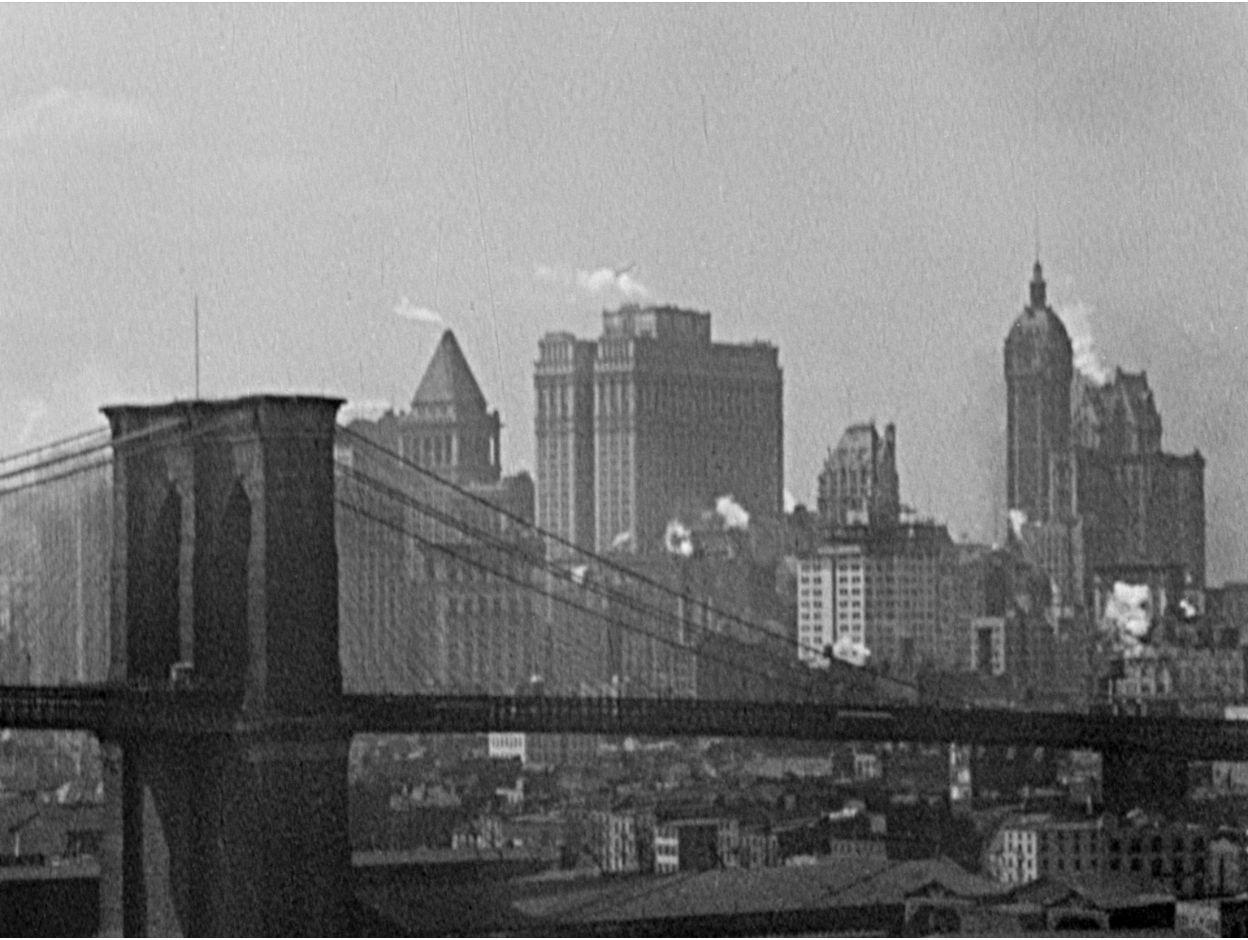
Sixty five shots
Manhatta is a short black and white film without dialogue, made by the photographer Paul Strand and the painter and photographer Charles Sheeler. The two shot most of it through 1920 and early 1921. It premiered in July 1921.
The whole film consists of 65 shots. There is no protagonist and no story. It opens with the Staten Island ferry approaching Manhattan and a crowd spilling onto the pier. Then come tall buildings, construction sites, rail lines, docks, tugboats. It closes with a sunset seen from the top of a skyscraper. Taken together, the shots form a single day in Lower Manhattan, from morning to evening.
Between the scenes are intertitles drawn from Walt Whitman. The title comes from his poem Mannahatta, an older spelling that recalls the island's name before the city rose on it. Whitman's words are exuberant and wide. Strand and Sheeler's images are still and tight.
A film camera that stands still
Both makers came from photography and painting, not cinema, and it shows in every frame. The camera barely moves. Each shot is composed like a photograph: a view from high above, a diagonal cutting across the frame, blocks of buildings arranged into planes of light and shadow.
Movement happens inside the frame, not in the camera. People flow in small streams at the foot of buildings. Smoke rises, spreads, disappears. A crane turns slowly. The view from above turns people into dark dots and the street into a geometric surface.
A few years earlier Strand had photographed New York streets in which pedestrians appear tiny beneath enormous stone walls. Sheeler would later paint factories, silos and steel bridges in clean, exact lines. Manhatta is where those two ways of seeing meet, testing what still photographs become when they are placed one after another in time.
America's first avant garde film
Manhatta is often described as the first American avant garde film. Yet it did not open in an art house. It was first shown at the Rialto, a large commercial cinema in New York, under the title New York the Magnificent. An experimental film, placed in the programme of a cinema built for the general public. In Paris it was screened as Fumée de New York. Only later did it become known as Manhatta.
Three names for one film say a lot. For a cinema audience it was a magnificent city. For Parisians it was smoke. For its makers it was an island, a place with its own name.
What keeps Manhatta watched more than a century later is not its value as a document. The city on screen has almost entirely changed. What remains is a way of seeing: the city not as a backdrop for a story but as the subject itself. Buildings, smoke, water and people carry the same weight in the frame. A generation of photographers and filmmakers learned from it.
The film also keeps a specific moment: New York around 1920, growing in steel and glass, still running on coal and steam. A city breathing out smoke.
Modern Art