
Essays · Olfactory Art
Oswaldo Maciá. Under the Horizon.
Some things only grow underneath.

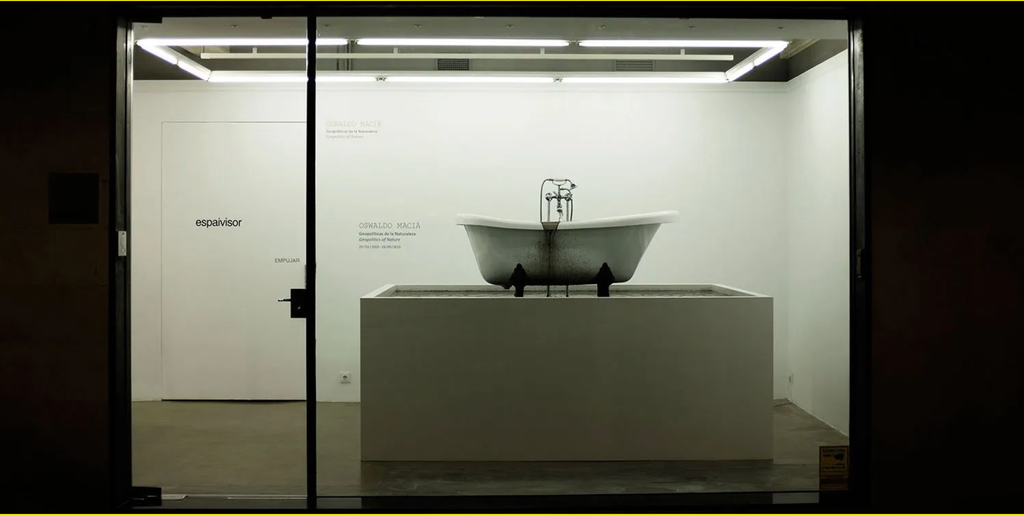
A bath on a plinth
In the middle of the room stands a plinth. On it, at eye level, is a bath. The taps are open and run constantly; no one turns them off. What pours out is not clear water. It is black.
That is all a visitor sees on entering Oswaldo Maciá's Under the Horizon. No figures, no wall text, no story told in pictures. The plinth is a convention of sculpture: it tells us that whatever sits on it deserves to be looked at. But the longer we look, the more we sense that information is missing.
Maciá was born in Colombia and lives and works in London. He describes what he makes as olfactory and acoustic sculpture. For him, smell and sound are real sculptural materials, on a par with stone, bronze or wood. They occupy space, have volume, have edges. The eye simply cannot see those edges.
The smell of under
The second part of the work is in the air. Maciá asked the perfumer Ricardo Moya to make a smell for the word under. It is an abstract word. It means nothing alone, only in relation to something else.
To give it a smell, they went into the ground. The scent draws on organisms that grow beneath the soil, specifically the carrot, taken from its seed. Visitors recognise something familiar, earthy, a little sweet, a little sharp. But there is no carrot in the room. The smell arrives without its object.
That gap is what unsettles people. We are used to having an image to anchor a smell. When the image is absent, the mind has to do the work: where does this come from, and what does it have to do with that black bath?
Sewing machines and artificial rain
The third part is sound, which Maciá calls Under sound. He recorded it in a large factory in Bulgaria that makes military uniforms for conflicts around the world. The steady, dense noise of machines stitching cloth is mixed with the sound of artificial rain.
Visitors may not know where the sound comes from. They hear a continuous murmur, like rain, like machinery, like something being made somewhere. Only when they read about the work do they learn they have been listening to the making of clothes that will be worn into war.
This is how Maciá brings geopolitics into an almost empty room. Not through slogans. Through a sound that lies beneath what we pay attention to.
Eight years of one work
Under the Horizon was first shown in 2011 at Schloss Marquardt, near Berlin, as part of Rohkunstbau XVIII. Maciá kept developing it for years; the dates he gives it are 2011 to 2019. In 2017 it was shown at the Centro Atlántico de Arte Moderno in Las Palmas de Gran Canaria, and in 2019 at espaivisor in Valencia, in the exhibition Geopolitics of Nature.
In 2018 it won an Art and Olfaction Award, a prize for works that put smell at their centre. For a piece with almost nothing to photograph, that is a notable recognition.
What stays after leaving the room is not the picture of the bath. It is a nagging sense that some things are still running, still growing, still being sewn, somewhere below the horizon of what we see.



Olfactory Art