
Essays · Photography
Zoe Leonard. Analogue.
Cửa tiệm đóng lại, bức ảnh ở lại.
The shop closes. The photograph stays.
Bắt đầu từ khu phố của mình
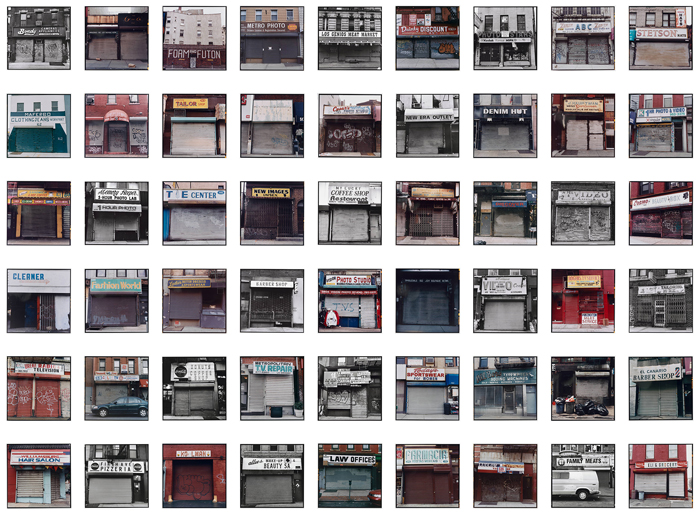
Cuối thập niên 1990, Zoe Leonard bắt đầu chụp khu phố bà đang sống: Lower East Side ở Manhattan, New York. Bà chụp mặt tiền cửa hàng, biển hiệu, tủ kính, những chi tiết nhỏ trên vỉa hè. Tiệm tạp hoá, tiệm bán đồ cũ, tiệm ảnh.
Đó là những cửa tiệm gia đình, mỗi tiệm một người chủ, một cách bày hàng riêng. Và chúng đang biến mất. Giá thuê tăng. Khu phố được làm mới. Chuỗi cửa hàng lớn thay thế từng góc phố. Leonard chụp chúng khi chúng vẫn còn mở cửa, nhưng đã có thể thấy trước ngày đóng.
Dự án kéo dài từ năm 1998 đến năm 2009. Hơn mười năm, bà quay lại những con phố ấy, có khi thấy một tiệm vẫn còn, có khi thấy tấm biển đã bị gỡ xuống.
Một chiếc máy ảnh cũ cho những thứ cũ
Leonard chụp bằng một chiếc Rolleiflex từ thập niên 1940. Bà gọi nó là một công cụ còn sót lại từ thời đại cơ khí. Đó không phải chi tiết kỹ thuật vô nghĩa. Những cửa tiệm bị bỏ lại được ghi bằng một chiếc máy cũng đang bị bỏ lại.
Máy Rolleiflex cho khung hình vuông. Ảnh được in bằng hai lối: in gelatin bạc cho ảnh đen trắng, in màu chromogenic cho ảnh màu, mỗi tấm khoảng 28 x 28 cm. Không bóng bẩy, không chỉnh sửa cho đẹp. Chúng trông như tư liệu, và chúng đúng là tư liệu.
Những gì trong khung hình rất bình thường. Biển hiệu bạc màu. Nhãn giá viết tay. Ma nơ canh. Bên trong một tiệm nhỏ chật hàng. Chính sự bình thường ấy là thứ đang mất: tính riêng của từng tiệm, sự đa dạng của một nền kinh tế nhỏ, lịch sử của một khu phố.
Theo dấu kiện quần áo cũ
Rồi Leonard đi xa hơn. Bà lần theo đường đi của hàng hoá cũ: quần áo đã qua sử dụng, biển quảng cáo bị bỏ, những tiệm ảnh Kodak của một công nghệ sắp hết thời. Chúng dẫn bà tới các chợ ở châu Phi, Đông Âu, Cuba, Mexico và Trung Đông.
Một hình ảnh lặp lại là kiện quần áo cũ, buộc chặt, được chuyển từ nơi này sang nơi khác. Nó xuất hiện ở New York, rồi lại xuất hiện trên một tấm biển vẽ tay của một nhà nhập khẩu quần áo cũ ở Kampala, Uganda. Rồi trong những khu chợ ở Kampala, áo sơ mi cũ được treo cẩn thận, che nắng, bày như trong tủ kính.
Như vậy, Analogue không chỉ là chuyện một khu phố. Nó cho thấy một mạng lưới. Thứ bị bỏ đi ở nơi này trở thành hàng hoá ở nơi khác. Toàn cầu hoá hiện ra qua những vật rất cụ thể.
412 bức ảnh, 25 chương
Bản đầy đủ của Analogue gồm 412 bức ảnh, chia thành 25 chương, treo thành lưới hoặc thành chuỗi dài. Tác phẩm ra mắt năm 2007, ở Wexner Center for the Arts và ở documenta 12. Về sau nó còn tồn tại dưới nhiều dạng khác: một bộ 40 bản in dye transfer, một cuốn sách, một căn phòng sắp đặt trọn vẹn. Bảo tàng Nghệ thuật Hiện đại New York đã trưng bày Analogue.
Đứng trước cả bức tường ảnh, người xem không nhìn từng cửa tiệm nữa. Họ thấy sự lặp lại. Tiệm này, tiệm kia, thành phố này, thành phố kia, cùng một kiểu đóng cửa. Quy mô của sự thay đổi chỉ hiện ra khi các ảnh đứng cạnh nhau.
Analogue vừa là tư liệu vừa là một bài tưởng niệm lặng lẽ. Nó ghi lại đời sống thường ngày đang phai, và cùng lúc đặt câu hỏi về những hệ thống khiến nó phai. Nó mời người xem nhìn chậm: cái gì còn, cái gì đã bị thay thế, và nhớ bằng hình ảnh nghĩa là gì.
Starting from her own street
In the late 1990s, Zoe Leonard began photographing the neighbourhood where she lived: the Lower East Side of Manhattan. She shot shopfronts, signs, windows, small details on the pavement. Groceries, secondhand stores, photo shops.
These were family businesses, each with one owner and its own way of arranging things. And they were disappearing. Rents rose. The neighbourhood was remade. Chain stores took over corner after corner. Leonard photographed them while they were still open, when their closing could already be foreseen.
The project ran from 1998 to 2009. For more than a decade she returned to those streets, sometimes finding a shop still there, sometimes finding its sign taken down.
An old camera for old things
Leonard used a Rolleiflex from the 1940s, a tool she described as left over from the mechanical age. That is not a trivial technical note. Shops being left behind were recorded by a camera that was itself being left behind.
The Rolleiflex gives a square frame. The prints were made two ways: gelatin silver for black and white, chromogenic prints for colour, each about 28 by 28 centimetres. Nothing glossy, nothing retouched. They look like documents, and they are documents.
What they show is ordinary. Faded signs. Handwritten price tags. Mannequins. The inside of a small, crowded shop. That ordinariness is exactly what was being lost: the character of each shop, the diversity of a small economy, the history of a street.
Following the bales
Then Leonard went further. She followed the path of used goods: secondhand clothing, discarded advertising, Kodak photo shops of a fading technology. They led her to markets in Africa, Eastern Europe, Cuba, Mexico and the Middle East.
One recurring image is the bale of used clothes, tightly bound, shipped from one place to another. It appears in New York, then again on a hand painted sign for a secondhand clothing importer in Kampala, Uganda. Then, in the markets of Kampala, used shirts hang carefully, shaded from the sun, displayed as if in a shop window.
So Analogue is not only about one neighbourhood. It maps a network. What is thrown away in one place becomes merchandise in another. Globalisation appears through very concrete things.
412 photographs, 25 chapters
The full Analogue consists of 412 photographs in 25 chapters, hung in grids or long sequences. It premiered in 2007, at the Wexner Center for the Arts and at documenta 12. It has since existed in other forms too: a set of 40 dye transfer prints, a book, a complete room installation. The Museum of Modern Art in New York has shown it.
Standing before the whole wall, the viewer stops seeing single shops. They see repetition. This shop, that shop, this city, that city, the same kind of closing. The scale of the change only appears when the pictures stand together.
Analogue is both document and quiet elegy. It records an everyday life that is fading, and questions the systems that make it fade. It asks us to look slowly: what survives, what has been replaced, and what it means to remember through images.
Photography